 Aug 31, 2026
Bhadra and the Remedies for Bhadra Dosha
Bhadra and the Remedies for Bhadra Dosha
धन्या दधमुखी भद्रा महामारी खरानना।
कालारात्रिर्महारुद्रा विष्टिश्च कुल पुत्रिका।
भैरवी च महाकाली असुराणां क्षयन्करी।
द्वादश्चैव तु नामानि प्रातरुत्थाय यः पठेत्।
न च व्याधिर्भवैत तस्य रोगी रोगात्प्रमुच्यते।
गृह्यः सर्वेनुकूला: स्यर्नु च विघ्रादि जायते।
भूलोकस्था सदा त्याज्या स्वर्ग-पातालगा शुभा।
रात्रि भद्रा यदाऽह्नि स्याद् दिवा भद्रा यदा निशि। न तत्र भद्रादोषः स्यात् सा भद्रा भद्रदायिनी।।
विष्टिरंगारकश्चैव व्यतीपातश्च वैधृतिः। प्रत्यरि-जन्मनक्षत्रं मध्याह्नात् परतः शुभम्।।
मुखे पंच गले त्वेका वक्षस्येकादश स्मृताः। नाभौ चतस्रः षट् कट्यां तिस्त्रः पुच्छाख्यनाडिकाः।। कार्यहानिः मुखे मृत्युर्गले वक्षासि निःस्वता। कट्यामुन्मत्तता नाभौ च्युतिः पुच्छे ध्रवो जयः।।
कार्योंऽत्यावश्यके विष्टेः मुखमात्रं परित्यजेत्।
धन्या दधिमुखी भद्रा महामारी खरानना। कालरात्रिर्महारुद्रा विष्टिस्च कुल पुत्रिका ।।
भैरवी च महाकाली असुराणां क्षयंकरी । द्वादशैव तु नामानि प्रातरुत्थाय यः पठेत्।।
⸻
Bhadra and the Remedy for Bhadra Dosha
In any auspicious or sacred ceremony, the occurrence of Bhadra is generally considered inauspicious. Both the beginning and completion of auspicious activities during Bhadra are traditionally regarded as unfavorable. According to the Puranas, Bhadra is believed to be the daughter of Lord Surya and Goddess Chhaya, and the sister of King Shani. Like Shani, her nature is also considered stern and severe.
According to Acharya Shripati, when Lord Shiva witnessed the defeat of the gods in the war between the Devas and Asuras, he became extremely angry. When his gaze fell upon his heart, a divine power manifested. Her form was described as having a donkey-like face, seven arms, three legs, a long tail, a lion-like neck, and a lean stomach. Riding upon a spirit, she proceeded to destroy the demons.
Pleased by this, the gods granted her a place near their ears. Therefore, she is said to have been included among the Karanas. In this manner, Bhadra is traditionally believed to have originated from the body of Lord Mahadeva. She is described as dark in complexion, with long hair, large teeth, a terrifying appearance, seven arms, a lean stomach, and the power to destroy demons.
⸻
Importance of Bhadra in the Panchang
The Hindu Panchang has five principal components:
* Tithi
* Vara (weekday)
* Nakshatra
* Yoga
* Karana
A Karana is half of a Tithi. There are a total of eleven types of Karanas. Among them, seven are movable (Chara) and four are fixed (Sthira).
The Seven Movable Karanas
* Bava
* Balava
* Kaulava
* Taitila
* Gara
* Vanija
* Vishti (Bhadra)
The Four Fixed Karanas
* Shakuni
* Chatushpada
* Naga
* Kinstughna
The seventh movable Karana is called Vishti, which is also known as Bhadra.
Bhadra is traditionally believed to move through the three worlds—Bhurloka (the earthly world), Swargaloka (the heavenly world), and Patalaloka (the netherworld). When Bhadra is present in Bhurloka, or the earthly realm, it is believed to create obstacles in important activities.
⸻
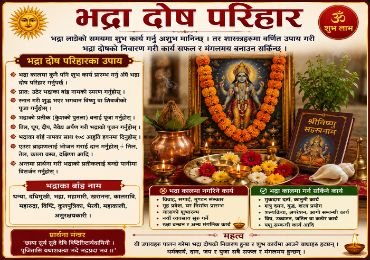
Bhadra Dosha Is Considered Remedied in the Following Four Situations
1. When Bhadra resides in Swarga (heaven) or Patala (the netherworld).
2. When Bhadra occurs at an unfavorable or opposite time.
3. When Bhadra occurs after midday.
4. During the tail period of Bhadra.
⸻
Residence of Bhadra in Heaven or the Netherworld
When Bhadra is in effect and the Moon is located in Aries, Taurus, Gemini, or Scorpio, Bhadra is considered to reside in heaven.
When the Moon is located in Virgo, Libra, Sagittarius, or Capricorn, Bhadra is considered to reside in the netherworld.
When the Moon is located in Cancer, Leo, Aquarius, or Pisces, Bhadra is considered to reside on Earth, or in Bhurloka.
According to the traditional scriptural view, only Bhadra residing in Bhurloka is considered particularly harmful. Bhadra residing in heaven or the netherworld is regarded as auspicious.
भूलोकस्था सदा त्याज्या स्वर्ग-पातालगा शुभा।
From this, it is understood that when the Moon is located in Aries, Taurus, Gemini, Virgo, Libra, Scorpio, Sagittarius, or Capricorn, the Bhadra occurring at that time is considered to reside in heaven or the netherworld and is therefore regarded as comparatively favorable for auspicious activities.
⸻
Bhadra Occurring at an Opposite Time
Bhadra occurring in the first half of the Tithi—namely on Krishna Paksha Saptami and Chaturdashi, and Shukla Paksha Ashtami and Purnima—is referred to as night Bhadra.
If daytime Bhadra occurs at night, or nighttime Bhadra occurs during the day, it is known as Bhadra occurring at an opposite or contrary time. Such Bhadra is regarded by traditional authorities as auspicious:
रात्रि भद्रा यदाऽह्नि स्याद् दिवा भद्रा यदा निशि। न तत्र भद्रादोषः स्यात् सा भद्रा भद्रदायिनी।।
This means that when night Bhadra occurs during the day, or day Bhadra occurs during the night, Bhadra Dosha does not exist, and such Bhadra is believed to bestow auspicious results.
⸻
Bhadra Occurring After Midday
Bhadra occurring before midday is generally considered inauspicious. Bhadra occurring after midday is traditionally regarded as auspicious.
विष्टिरंगारकश्चैव व्यतीपातश्च वैधृतिः। प्रत्यरि-जन्मनक्षत्रं मध्याह्नात् परतः शुभम्।।
Bhadra is also given different names according to the day of the week. Bhadra occurring on Monday and Friday is called Kalyani; Bhadra on Saturday is called Vrishchiki; Bhadra on Thursday is called Punyavati; and Bhadra occurring on Sunday, Tuesday, and Wednesday is called Bhadrika.
⸻
The Tail Period of Bhadra
According to Kashyapa Samhita:
मुखे पंच गले त्वेका वक्षस्येकादश स्मृताः। नाभौ चतस्रः षट् कट्यां तिस्त्रः पुच्छाख्यनाडिकाः।। कार्यहानिः मुखे मृत्युर्गले वक्षासि निःस्वता। कट्यामुन्मत्तता नाभौ च्युतिः पुच्छे ध्रवो जयः।।
This means that within the traditional period of 30 Ghadis of Bhadra:
* The first 5 Ghadis are called the Mouth
* The next 1 Ghadi is called the Neck
* The following 11 Ghadis are called the Chest
* The next 4 Ghadis are called the Navel
* The following 6 Ghadis are called the Waist
* The final 3 Ghadis are called the Tail
Traditionally, the Mouth period is associated with loss or failure of work, the Neck period with fear of death, the Chest period with poverty, the Waist period with mental instability, the Navel period with downfall, and the Tail period with certain victory.
If the duration of Bhadra exceeds 30 Ghadis, the calculation of the Mouth and other bodily divisions may also increase proportionately.
In traditional Muhurta texts, the Mouth period of Bhadra is regarded as inauspicious, while the Tail period is considered auspicious. In situations of extreme necessity, it is mentioned that work may be undertaken by avoiding the Mouth period of Bhadra.
कार्योंऽत्यावश्यके विष्टेः मुखमात्रं परित्यजेत्।
⸻
The Mouth and Tail of Bhadra in Different Tithis
Paksha Tithi Mouth of Bhadra Tail of Bhadra
Krishna Tritiya At the beginning of the fourth Prahara, up to one-sixth of Bhadra At the end of the third Prahara, up to one-tenth of Bhadra
Krishna Saptami At the beginning of the third Prahara, up to one-sixth of Bhadra At the end of the second Prahara, up to one-tenth of Bhadra
Krishna Dashami At the beginning of the second Prahara, up to one-sixth of Bhadra At the end of the first Prahara, up to one-tenth of Bhadra
Krishna Chaturdashi At the beginning of the first Prahara, up to one-sixth of Bhadra At the end of the fourth Prahara, up to one-tenth of Bhadra
Shukla Chaturthi At the beginning of the first Prahara, up to one-sixth of Bhadra At the end of the fourth Prahara, up to one-tenth of Bhadra
Shukla Ashtami At the beginning of the second Prahara, up to one-sixth of Bhadra At the end of the first Prahara, up to one-tenth of Bhadra
Shukla Ekadashi At the beginning of the third Prahara, up to one-sixth of Bhadra At the end of the second Prahara, up to one-tenth of Bhadra
Shukla Purnima At the beginning of the fourth Prahara, up to one-sixth of Bhadra At the end of the third Prahara, up to one-tenth of Bhadra
Summary
1. Bhadra residing in heaven or the netherworld is considered auspicious, while Bhadra residing in Bhurloka is considered capable of causing dosha.
2. Even Bhadra residing in Bhurloka is considered favorable when it occurs at an opposite or contrary time.
3. Even if Bhadra in Bhurloka does not occur at an opposite time, it may be considered favorable when it occurs after midday.
4. In situations of extreme necessity, work may be undertaken by avoiding the Mouth period of Bhadra. If possible, priority should be given to the Tail period.
कार्योंऽत्यावश्यके विष्टेः मुखमात्रं परित्यजेत्।
5. The Tail period of Bhadra is regarded as particularly auspicious.
6. There is a religious belief that a person who remembers the twelve names of Bhadra upon waking in the morning will have their activities completed without obstacles.
धन्या दधिमुखी भद्रा महामारी खरानना। कालरात्रिर्महारुद्रा विष्टिस्च कुल पुत्रिका ।।
भैरवी च महाकाली असुराणां क्षयंकरी । द्वादशैव तु नामानि प्रातरुत्थाय यः पठेत्।।
न च व्याधिर्भवैत तस्य रोगी रोगात्प्रमुच्यते।
गृह्यः सर्वेनुकूला: स्यर्नु च विघ्रादि जायते।
This means that Dhanya, Dadhimukhi, Bhadra, Mahamari, Kharanana, Kalaratri, Maharudra, Vishti, Kulaputrika, Bhairavi, Mahakali, and Asurakshayakari are the twelve names. According to religious belief, remembering these twelve names in the morning makes Bhadra bestow auspicious results.
⸻
Activities Traditionally Avoided During Bhadra
During Bhadra, the following auspicious activities are generally considered prohibited:
* Marriage ceremonies
* Mundan (first hair-cutting ceremony)
* House entry ceremonies
* Beginning of house construction
* Auspicious rituals related to Raksha Bandhan
* Beginning a new business
* Auspicious journeys
* Other auspicious and sacred activities
It is stated in Muhurta Martanda:
“ईयं भद्रा शुभ-कार्येषु अशुभा भवति”
This means that Bhadra is considered inauspicious for auspicious activities.
Sage Kashyapa also advised against performing auspicious ceremonies during Bhadra:
न कुर्यात मंगलं विष्ट्या जीवितार्थी कदाचन।
कुर्वन अज्ञस्तदा क्षिप्रं तत्सर्वं नाशतां व्रजेत।।
This means that a person wishing for a prosperous life should not perform any auspicious activity during Bhadra. According to traditional belief, if such an activity is performed unknowingly, its results may be destroyed.
⸻
Activities That May Be Performed During Bhadra
According to traditional Muhurta principles, although Bhadra is considered unfavorable for auspicious activities, it is regarded as suitable for certain harsh, difficult, or conflict-related activities. Examples include:
* Matters related to legal disputes
* Activities related to overcoming enemies
* War or conflict-related activities
* Activities involving fire
* Activities involving the use of weapons
* Certain activities involving animals
* Essential treatments or procedures such as surgery
In such matters, modern legal, medical, and safety principles must always be given priority.
⸻
Traditional Remedies for Bhadra Dosha
On a day when Bhadra is present, if an auspicious activity must be performed due to an extremely necessary situation, traditional practices mention observing a fast and performing worship.
After bathing in the morning and offering Tarpana to the deities and ancestors, a symbolic image of Bhadra is traditionally made from Kusha grass. It is then worshipped with flowers, incense, lamps, fragrance, and Naivedya.
There is also a traditional practice of offering 108 oblations into the sacred fire while reciting the twelve names of Bhadra and giving charity and Dakshina according to one’s capacity.
At the conclusion of the worship, the following prayer is recited:
‘छाया सूर्य सुते देवि विष्टिरिष्टार्थदायिनी।
पूजितासि यथाशक्त्या भदे भद्रप्रदा भव॥’
Traditionally, donations of sesame seeds, oil, a black cow, a black blanket, and Dakshina according to one’s capacity are mentioned. After the worship, the symbolic image of Bhadra is traditionally immersed or ritually disposed of according to the prescribed method.
⸻
What Is Bhadra?
Bhadra generally refers to the Vishti Karana. When Vishti Karana occurs in either the first or second half of a Tithi, that Tithi is called a Bhadra-yukta Tithi, meaning a Tithi associated with Bhadra.
The five components of the Panchang are:
* Tithi
* Vara
* Nakshatra
* Yoga
* Karana
A Karana is half of a Tithi. Normally, one Tithi contains two Karanas.
There are eleven types of Karanas:
बवबालवकौलवतैतिलगरवाणिज्यविष्टयः सप्त |
शकुनि चतुष्पदनागकिन्स्तुघ्नानि ध्रुवाणि करणानि ||
The eleven Karanas are:
1. Bava
2. Balava
3. Kaulava
4. Taitila
5. Gara
6. Vanija
7. Vishti
8. Shakuni
9. Chatushpada
10. Naga
11. Kinstughna
Among these, Vishti Karana is known as Bhadra.
⸻
When Does Bhadra Occur?
According to Muhurta Chintamani:
शुक्ले पूर्वार्धेष्टमीपञ्चदश्योर्भद्रैकादश्यां स्याच्चतुर्थ्यांपरार्धे |
कृष्णेन्त्यार्धे स्यातृतीयादशम्योः पूर्वे भागे सप्तमीशंभुतिथ्योः ||
This means:
During Shukla Paksha
* Ashtami — in the first half
* Purnima — in the first half
* Chaturthi — in the second half
* Ekadashi — in the second half
During Krishna Paksha
* Tritiya — in the second half
* Dashami — in the second half
* Saptami — in the first half
* Chaturdashi — in the first half
Regarding the Mouth and Tail of Bhadra, Muhurta Chintamani states:
पंचद्वयद्रकृताष्टरामरसभूयामादिघट्यः शराविष्टेरासस्य मसद्गजेन्दुरसरामाध्रश्विबाणाब्धिषु ||
यामेष्वंत्यघटीत्रयं शुभकरं पुच्छं तथा वासरे विष्टिस्तिथ्यपरार्धजा शुभकरी रात्रौतु पूर्वार्धजा ||
⸻
The Twelve Names of Bhadra
1. Dhanya
2. Dadhimukhi
3. Bhadra
4. Mahamari
5. Kharanana
6. Kalaratri
7. Maharudra
8. Vishti
9. Kulaputrika
10. Bhairavi
11. Mahakali
12. Asurakshayakari
⸻
Bhadra’s Residence in the Three Worlds
World Zodiac Signs in Which the Moon Is Located
Heaven (Swargaloka) Aries, Taurus, Gemini, Scorpio
Netherworld (Patalaloka) Virgo, Libra, Sagittarius, Capricorn
Earth (Bhurloka) Cancer, Leo, Aquarius, Pisces
स्वर्गे भद्रा शुभं कुर्यात पाताले च धनागम।
मृत्युलोक स्थिता भद्रा सर्व कार्य विनाशनी ।।
This means that Bhadra residing in heaven is considered auspicious, Bhadra residing in the netherworld is believed to bring wealth, and Bhadra residing in the earthly world is traditionally believed to create obstacles or destruction in activities.
⸻
The Main Remedy for Bhadra Dosha
दिवा भद्रा रात्रौ रात्रि भद्रा यदा दिवा।
न तत्र भद्रा दोषः स्यात सा भद्रा भद्रदायिनी।।
This means that when daytime Bhadra occurs at night and nighttime Bhadra occurs during the day, Bhadra Dosha does not apply, and such Bhadra is regarded as favorable.
तिथे पूर्वार्धजा रात्रौ दिन भद्रा परार्धजा।
भद्रा दोषो न तत्र स्यात कार्येsत्यावश्यके सति।।
This means that when an extremely necessary activity must be performed, traditional practices may consider the effect of Bhadra Dosha to be reduced after appropriate remedies and Muhurta considerations.
⸻
Special Note
According to some traditions, Bhadra during Shukla Paksha is called Vrishchiki, while Bhadra during Krishna Paksha is called Sarpini. Differences of opinion regarding this subject are also found in various texts and traditions.
Similarly, different Muhurta texts mention different methods for calculating the Mouth and Tail of Bhadra. Therefore, for an actual auspicious ceremony or important event, it is advisable to make a decision according to a reliable local Panchang and the calculations of a qualified astrologer.
⸻
Conclusion
Bhadra, or Vishti Karana, is an important subject in the Hindu Panchang and the science of Muhurta. Although Bhadra is generally considered unsuitable for auspicious and sacred activities, its effect is not considered the same in every situation.
The remedies or exceptions to Bhadra Dosha are traditionally considered in the following situations:
* When Bhadra resides in heaven or the netherworld
* When it occurs at an opposite or contrary time
* When it occurs after midday
* During the Tail period of Bhadra
* In situations of extreme necessity, when the Mouth period is avoided and an appropriate Muhurta is considered
धन्या दधिमुखी भद्रा महामारी खरानना। कालरात्रिर्महारुद्रा विष्टिस्च कुल पुत्रिका ।।
भैरवी च महाकाली असुराणां क्षयंकरी । द्वादशैव तु नामानि प्रातरुत्थाय यः पठेत्।।
न च व्याधिर्भवैत तस्य रोगी रोगात्प्रमुच्यते।
गृह्यः सर्वेनुकूला: स्यर्नु च विघ्रादि जायते।




 EN
EN
 By - Super Admin
 0 comments
 Tag
Tag
Comments ( 00 )
No comments yet.